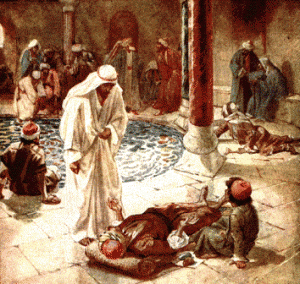
The fifth chapter of John, like all of the Bible, provides rich encouragement for the hungry soul. It’s a story of a lifelong paralytic who is instantly healed at the Words of Jesus (quoted below). Because of his awful condition, this man had spent the majority of his life pitifully-unable to fend for himself, provide for himself, or heal himself. When the water was stirred by the angel of the Lord, someone always made it to the fountain before him, and they were healed while he was not. He didn’t even have any friends to help! For this reason, this story is often told primarily in a negative light. We read about this man and our hearts often grow judgmental toward him and his circumstances: Surely he must have caused this chaos, right? We read and marvel that he has languished, help-free, for 38 years! Maybe he should just pick himself up by his bootstraps? Maybe not?
Recently, as I was reading this chapter again, the Lord began to show me this man’s story from a far different perspective: Jesus showed me just a glimpse of how He sees this pitiful, paralyzed man, and those like him. As I read more and more, this story began to display a vivid picture of a hungry people who, though obviously struggling with the infirmities of their flesh, are yet found waiting on the moving of the Holy Ghost! In fact, it becomes a privilege for them to wait on the Lord – it becomes a privilege to wait patiently for His true glory to be revealed within them. How precious! Just for a moment, let’s peak into this short story from a bit of a different angle – let’s see this man as one of patient expectation and endurance through suffering. Friends, Jesus is moved by this kind of people!
Let’s read John 5:1-9 to understand the context:
“After this there was a feast of the Jews; and Jesus went up to Jerusalem. Now there is at Jerusalem by the sheep market a pool, which is called in the Hebrew tongue Bethesda, having five porches. In these lay a great multitude of impotent folk, of blind, halt, withered, waiting for the moving of the water. For an angel went down at a certain season into the pool, and troubled the water: whosoever then first after the troubling of the water stepped in was made whole of whatsoever disease he had. And a certain man was there, which had an infirmity thirty and eight years. When Jesus saw him lie, and knew that he had been now a long time in that case, he saith unto him, Wilt thou be made whole? The impotent man answered him, Sir, I have no man, when the water is troubled, to put me into the pool: but while I am coming, another steppeth down before me. Jesus saith unto him, Rise, take up thy bed, and walk. And immediately the man was made whole, and took up his bed, and walked: and on the same day was the sabbath.”
There are 5 Greek words the Bible uses to describe the awful state of this paralytic man, and those like him (underlined above). Let’s examine these Greek words together and see how accurately they may describe us!
Impotent
The Greek word used here is astheneo, and means, “To be feeble in any sense; to be diseased; to be impotent (unable to reproduce); to be made weak.” It comes from a root word, asthenes, which means, “To be strengthless literally, figuratively, or morally.”
The word astheneo is used throughout the New Testament, and not only to refer to natural ailments – its usage elsewhere will shed further light upon our narrative:
- Paul uses the word astheneo to describe the weakness of the Law (Rom. 8:3). It could not remove the stain of man’s sin; it only covered it, and that temporarily.
- This word is used to describe Jesus in 2 Corinthians 13:4. It says, “He was crucified in weakness“, meaning, Jesus purposefully abstained from the use of His divine strength during His crucifixion. He could have easily overcome His captors and His cross, but He chose to endure it all for “the joy that was set before Him” (Heb. 12:2).
- Paul uses this word to describe our human weaknesses that must learn to rely upon the strength and power of God (2 Cor. 12:10). In fact, in 2 Corinthians 11:29, Paul uses this word to admit to his own weaknesses: “Who is weak, and I am not weak? Who is made to stumble, and I do not burn with indignation?” He even gloried in these infirmities (vs. 30) because he knew the promised fruit to come as a result, namely, divine strength which only God can provide!
- The word astheneo is used to describe Abraham, who was not “weak in faith” (Rom. 4:19), as well as others who, in fact, were (Rom. 14:1-2, 21; 1 Cor. 8:9).
Notice how this word for impotent is used in both negative and positive contexts. So it is with us, I believe. The trouble and impotencies that we may face can actually become opportunities to overcome and be made more like Jesus. The only question is, will we allow God to have His perfect work in us? Or will we allow our impotencies to derail us? Reader, do we still have faith to wait upon the Lord when our weaknesses are staring at us in the face?
Blind
This Greek word tuphlos means, “To be physically or mentally blind; to see opaquely (as if smoky).” This word comes from a root word, tuphoo, which means, “To envelop with smoke; to inflate with self conceit; to be high-minded or proud”. The natural meaning is obvious, but let’s observe how else tuphlos is used in the New Testament:
- Paul uses this word to describe those who are yet in darkness, that is, the unsaved (Rom. 2:19). Yes, the “god of this world” has blinded the minds of those who don’t believe (often by pride), and its only “the light of the glorious gospel of Christ” that can heal such awful, dark eyesight (2 Cor. 4:3-4; Jn. 9:40-41; 1 Jn. 2:9-11).
- Peter also uses the word tuphlos to describe those who are spiritually “shortsighted, even to blindness“, having “forgotten that he was cleansed from his old sins” (2 Pet. 1:9).
- John uses this word in Revelation 3:17 when he describes the church at Laodicea. He calls them “wretched, miserable, poor, blind, and naked“.
It is clear that blindness is an awful state – and spiritual blindness is even worse. It is also clear, however, that Jesus shows great mercy to the blind when they cry out to Him in repentance – He heals both natural and spiritual blindness. He both cures our physical ailments, and He equips the hungry with spiritual sight that no darkness can overpower.
“The Spirit of the Lord is upon me, Because he hath anointed me to preach the gospel to the poor; He hath sent me to heal the brokenhearted, to preach deliverance to the captives, And recovering of sight to the blind, To set at liberty them that are bruised, To preach the acceptable year of the Lord” (Lk. 4:18-19).
Halt
This Greek word is cholos, and means, “Limping; to be cripple or lame; to be deprived of a foot, or maimed”. Let’s observe how else this word is used in Scripture:
- Acts 14:8 translates cholos as “cripple“, that is, “a man without strength in his feet“. This can speak to us of both natural and spiritual lameness. Feet throughout Scripture are symbolic of one’s personal walk throughout life, either with Jesus or with the world (Ps. 119:32; Prov. 4:26-27; Isa. 35:3, 8-10; 52:7; Phil. 3:17). As such, spiritual lameness refers to our inability to do so. If we are spiritually halt and lame, then we are spiritually stagnant and immobile – we are not using our “feet” to run after the prize of the high calling of God in Christ Jesus (Phil. 2:16; 3:14; Heb. 12:1; 1 Pet. 4:4)! As always, the Lord can and will heal such lameness in our feet! All we have to do is ask!
- The writer to the Hebrews uses this word to encourage his readers toward fruitfulness: “Now no chastening for the present seemeth to be joyous, but grievous: nevertheless afterward it yieldeth the peaceable fruit of righteousness unto them which are exercised thereby. Wherefore lift up the hands which hang down, and the feeble knees; and make straight paths for your feet, lest that which is lame be turned out of the way; but let it rather be healed” (Heb. 12:11-13). The implication is clear. To be cholos (lame/halt) is to be “turned out of the way” (vs. 13)! But Jesus heals our depravity by drawing us after Himself! As we follow Him, worship Him, and adhere to His Words, our paths begin to straighten under our feet, and our lameness is healed! What a merciful God we serve.
Withered
The Greek word used here for withered is xeros. It means, “Scorching or arid; shrunken due to a lack of water; to be deprived of one’s natural juices.”
- This word signifies spiritual dryness and deformity, which are often the fruits of sin and disobedience: “Blessed is the man that walketh not in the counsel of the ungodly, nor standeth in the way of sinners, Nor sitteth in the seat of the scornful. But his delight is in the law of the LORD; And in his law doth he meditate day and night. And he shall be like a tree planted by the rivers of water, That bringeth forth his fruit in his season; His leaf also shall not wither; And whatsoever he doeth shall prosper” (Ps. 1:1-3).
- Most of the time, it was the hands of a person that grew withered (Matt. 12:10; Mk. 3:3; Lk. 6:6). Hands throughout Scripture, much like feet, are often used symbolically to refer to a man’s works (Ps. 26:6; 24:3-4; 90:17; Prov. 6:10; Eccl. 4:5; 1 Tim. 2:8; Lam. 3:41; Ps. 141:2). Hands are the instruments of the heart: their visible works reveal the invisible motives of a man, whether they be good or bad, pure or evil. Withered hands, therefore, signify hands that cannot or will not properly serve, give, work, or help – they’ve been dried up by the wilderness of sin. This was the painful state of the paralytic (and those like him) as he waited for his healing. This was just a part of the pitiful mess in which he was found!
Waiting
The fifth and final word used to describe this paralyzed man is also found in verse 3. The Greek word is ekdechomai, and it means, “To await, expect, look for, or tarry for”. The man was waiting on the moving of the water, that is, the moving of the Holy Spirit to foster the miraculous. Though pitiful, he had an expectation that many do not. Like Paul, this man’s weakness was not unto fruitlessness:
“So I am well pleased with weaknesses, with insults, with distresses, with persecutions, and with difficulties, for the sake of Christ; for when I am weak [in human strength], then I am strong [truly able, truly powerful, truly drawing from God’s strength]” (2 Cor. 12:10, AMP).
What good news for us! Our withered hands and lame feet do not have to dictate our future! Even staunch blindness can be met with divine mercy and empowerment! Our weaknesses do not have to be unto fruitlessness: Simply wait for Jesus to pass by!
Finally, let’s examine a few other instances in which ekdechomai is used in the New Testament. Again, as we observe its usage elsewhere, our study will be enlightened.
- Ekdechomai is the same Greek word used in Hebrews 10:13 and 11:10. Though translated differently into English, the Hebrew epistle uses this same Greek word, ekdechomai, to describe the faithful and patient waiting of both Jesus (Heb. 10) and Abraham (Heb. 11).
- And every priest standeth daily ministering and offering oftentimes the same sacrifices, which can never take away sins: but this man, after he had offered one sacrifice for sins for ever, sat down on the right hand of God; from henceforth expecting till his enemies be made his footstool” (Heb. 10:11-13).
- “By faith Abraham, when he was called to go out into a place which he should after receive for an inheritance, obeyed; and he went out, not knowing whither he went. By faith he sojourned in the land of promise, as in a strange country, dwelling in tabernacles with Isaac and Jacob, the heirs with him of the same promise: for he looked for a city which hath foundations, whose builder and maker is God” (Heb. 11:8-10).
We know from these examples that such waiting does not guarantee to be an apathetic process. The sort of waiting that God honors is that which is done in faith, by the grace of God. Earthly-minded men will look at this mindset and scoff at people like the paralytic. “He should at least try and crawl to the water, right!?” However, when Jesus looks at the paralytic He sees a bit of a different scene. Yes, the man is terribly impotent, blind, halt and withered… But he’s also waiting! He is waiting with whatever meager portion of faith he can muster, and Jesus is stopped in His tracks because of it!
Friends, we learn from this story that there is no struggle too great where Jesus isn’t greater still. There is no shadow too dark, no hole too deep, no crookedness too bent, and no death too strong. Even time itself is in His hands – all 38 years of the paralytic’s life! Jesus has overcome all things: He owns all things and is the Heir of all things (Heb. 1:1-2). He even owns your ailments and troubles, and He will turn them into fruit! Don’t lose hope! Jesus is ever-faithful to His promises. He mercifully met the paralytic man even among his dire weaknesses, and He will meet with you and I just the same. His mercies are without partiality. He specializes in turning heaps of ashes into mountains of beauty. And for those heaps of ashes now reading this post, let’s call it a privilege to wait upon our Maker for mountains. For He always does what’s good, and He always arrives on time!
“He raiseth up the poor out of the dust, And lifteth up the beggar from the dunghill, To set them among princes, And to make them inherit the throne of glory” (1 Sam. 2:8).
“He raiseth up the poor out of the dust, And lifteth the needy out of the dunghill; That he may set him with princes, Even with the princes of his people. He maketh the barren woman to keep house, And to be a joyful mother of children. Praise ye the LORD” (Ps. 113:7-9).
“Then Pharaoh sent and called Joseph, and they brought him hastily out of the dungeon: and he shaved himself, and changed his raiment, and came in unto Pharaoh… thou shalt be over my house, and according unto thy word shall all my people be ruled: only in the throne will I be greater than thou. And Pharaoh said unto Joseph, See, I have set thee over all the land of Egypt. And Pharaoh took off his ring from his hand, and put it upon Joseph’s hand, and arrayed him in vestures of fine linen, and put a gold chain about his neck; and he made him to ride in the second chariot which he had; and they cried before him, Bow the knee: and he made him ruler over all the land of Egypt” (Gen. 41:14, 40-43).
 The Hungry Soul