 Part 16
As we’ve said, because of the superior glories of our Lord’s heavenly sanctuary, we now find ourselves graced with potential for superior fruit. What sort of fruit? Fruits of a goodly sort! These particular inward crops are seen in Paul’s discussion of the tabernacle’s inner contents. Each article of furniture is symbolic, and serves as a “figure of the true” bounty Jesus grows upon His saints (Heb. 9:24). They typify the sort of spiritual production to be harvested by each New Covenant priest, as he treks down his tabernacle journey. Observe.
First and foremost, we learn of a better spiritual walk. This particular fruit isn’t seen by the tabernacle furniture, but by the priest’s walk through the tabernacle structure. The Bible uses this trek in a metaphorical sense, as a symbol of our spiritual journey toward God’s fullness (Heb. 4:6). Like those priests within the earthen tabernacle, we too are on a race toward the throne-room.
“Know ye not that they which run in a race run all, but one receiveth the prize? So run, that ye may obtain. And every man that striveth for the mastery is temperate in all things. Now they do it to obtain a corruptible crown; but we an incorruptible” (1 Cor 9:24-25).
The heavenly sanctuary is far superior simply because it furnishes a spiritual path, not a natural. It’s called “the path of the just” (Prov. 4:18) and the “narrow way” unto life (Matt. 7:13-14). It’s named “a new and living way… through the veil” (Heb. 10:20-23), and “the way of holiness” that no wayfaring man may pass over (Isa. 35:8; 19:23). We walk this passage as we grow from “strength to strength” (Ps. 84:7), from little faith to increased faith (Rom. 1:17), from one measure of glory to another (2 Cor. 3:18), and from spiritual infancy to aged maturity (Gal. 4:19; Heb. 5:12-14). Paul compared this road to a physical race that is run (1 Cor. 9:24): It will bring us to an “expected end”, that is, the ultimate fruition of our spiritual growth, the very top of God’s “secret stairs”, and the very throne of God (Jer. 29:11; Song. 2:14; Rev. 3:21; Gal. 4:19).
To refuse this priestly trek is to embrace an alternative road. All other paths will be “broad” ones, and they lead only to spoilage and misery (Matt. 7:13). The Bible calls it “the way of Cain” (Jude 11), and “the way of the wicked” (Prov. 4:19). It is a blindly-led path, and a walk full of stumbles and darkness (Matt. 15:14; Jn. 12:35; 1 Jn. 2:11; Jer. 13:16). Any true priest must embrace our Lord’s better and righteous path. The Lord Jesus has already paved the road for us – all we must do is follow in His steps (Heb. 6:19-20; 4:14; 9:12, 24; 1 Pet. 3:22; Jn. 14:2).
“Blessed is the man that walketh not in the counsel of the ungodly, nor standeth in the way of sinners, nor sitteth in the seat of the scornful. But his delight is in the law of the Lord; and in his law doth he meditate day and night. And he shall be like a tree planted by the rivers of water, that bringeth forth his fruit in his season; his leaf also shall not wither; and whatsoever he doeth shall prosper” (Ps. 1:1-3).
Secondly, our Lord’s superior house births superior illumination: it is superior because it is spiritual in nature, not only natural. We see this fruit as we enter the first door of the tabernacle structure: Here, we find “the [golden] candlestick” (Heb. 9:2).
This candlestick was a very important instrument because it was the Holy Place’s only source of light for the. No natural light could seep through the structure, so the candlestick was essential for priestly duties to be performed (Lev. 24:1-4). As such, the candlestick is a clear symbol of the “light” and illumination given by the Holy Spirit, as well as the brightness of God’s presence amidst the great darkness of our world (Ps. 18:28; Jn. 1:9; 7:17; 8:12; 12:35, 46). Like the priests in the natural sanctuary, believers too need for God to light the way – He’s our only hope for a path trodden aright (Isa. 50:10; Job 33:28). We mustn’t rely on the Outer Court’s light, that is, on worldly light or intellectual instruction: Such a dim glare will never furnish a fruitful path. If we ignore the golden candlestick’s provision then our illumination, if any, will be scarce. We will know only of blood and know nothing of glory. Let us rather seek the Holy Spirit’s bright guidance, and let us trust in the shining of His wisdom alone. May we be a people who faithfully trim our wicks and thereby have light without end. Reader, this is the better fruit which our Lord’s sanctuary will furnish!
Thirdly, we learn of promised rich spiritual meat. This fruit is well-seen in the next article found in the Holy Place, “the table of shewbread” (Heb. 9:2). The table of shewbread held the fresh bread the priests ate: they ate it together as a memorial unto the Lord (Lev. 24:7-9). This shewbread is symbolic of the person of the Lord Jesus Christ (as the bread of heaven) and of His nourishing and sustaining Word (Jn. 1:1; 6:32-35, 50, 55, 58). This spiritual sanctuary is more fruitful because it feeds us with spiritual manna, not natural: Yes, the Lord’s Table is a spiritual one (1 Cor. 10:17-22). Paul taught the Hebrews that a grasp upon the mere natural pattern would be to insist on far-lesser fruit (Matt. 9:36; Jn. 10:1). Jesus should be the winner of our gaze, for He sustains His flock through every wilderness (Jn. 10:9) and He furnishes feast after feast of spiritual meat (Jn. 6:55; Ps. 23:1-6; Heb. 5:12-14).
This shewbread has also been called “the bread of faces”, as it is the place from which we grow most-intimate with God and receive great glimpses of His character (2 Cor. 4:6; Lk. 10:22; 1 Jn. 1:9; Jn. 1:14; 3:13; 14:9-10; Col. 1:15; Heb. 1:3). How much greater is this heavenly bread! How much more fruitful is the Lord of this heavenly sanctuary! Yes, Jesus bakes the richest of all manna, for His bread reveals the very “face” of God (2 Cor. 4:6). Why should Paul’s readers cling to the earthly and lesser? King Jesus bears far-sweeter fruit.
Next, Paul tells us of the great spiritual communion we may now share. The depths of this truth are figuratively seen in the third instrument, “the golden censer”, also known as the altar of incense (Heb. 9:4). This “censer” was the structure upon which priests burned their continual incense: It was then brought within the veil, into the Most Holy Place (Lev. 16:12-13). The list of ingredients used for this incense was very specific, and it was considered “holy for the Lord” (Exod. 30:1-10, 34-38). Again, these details become symbolic for us. The censer represents the intercession and pure worship that ascends toward God’s spiritual throne (mercy seat), as it wafts through the veil of the heavenly sanctuary (Rev. 8:3-4; Jn. 4:23-24; Rom. 8:26-27, 34; Heb. 7:25). The incense we offer is spiritual in nature (Ps. 141:1-2; Rev. 5:8; 1 Cor. 1:2; Mal. 1:11).
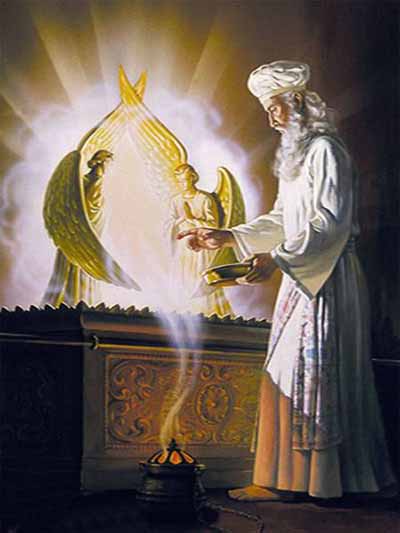
Lastly, but certainly not least, we learn of our coming spiritual fullness. This, yet again, is seen by the figurative nature of the tabernacle’s final piece of furniture, “the ark of the Covenant” (Heb. 9:4). The Bible uses the ark as an emblem of victory (Ps. 132:8; Num. 10:35-36), of blessing (2 Sam. 6:11), and of God’s glory (Lev. 16:2; Josh. 7:6; Jdg. 20:27; 2 Sam. 7:2; Ps. 78:61; 80:1; 99:1). Furthermore, because of the ark’s unique location in the tabernacle, its also used an emblem of God’s fullness.
The ark was uniquely located in the Most Holy Place, the final and most holy division of the sanctuary structure (Exod. 25:16). It’s was the only article of furniture found there. As we’ve said, there was a veil hanging at the entrance of the Most Holy Place in times past; it was to separate the two divisions of the sanctuary. (Exod. 26:33). This division served to display the great breach that existed between God’s perfect glory (the ark) and man’s sin. In by-gone days, no provision had yet been made for mankind’s total redemption, and thus a veil must be hung to bar his entrance into God’s presence. This veil, however, was rent from top to bottom when Jesus offered His life on the cross (Mk. 15:38). As such, mankind now has access into the very fullness of God’s presence and glory. The ark, and the Most Holy Place in which it resides, is symbolic of our attainment of God’s glory, and our full union unto Him as a bride without spot (Eph. 5:25-32). The Bible likens such fullness to the “hope” of the church, and to our coming inheritance (Heb. 12:3-17). Indeed, we have “hope” set before us to “entereth into that within the veil” (Heb. 6:19). We can readily hope for such glory because Jesus has already entered as our Forerunner (Heb. 6:20). It is our very calling (1 Thess. 2:12)!
“Therefore being justified by faith, we have peace with God through our Lord Jesus Christ: By whom also we have access by faith into this grace wherein we stand, and rejoice in hope of the glory of God” (Rom. 5:1-2).
“To whom God would make known what is the riches of the glory of this mystery among the Gentiles; which is Christ in you, the hope of glory: Whom we preach, warning every man, and teaching every man in all wisdom; that we may present every man perfect in Christ Jesus” (Col. 1:27-28).
To be continued…
 The Hungry Soul