 Part 10
Paul now shifts his focus toward Aaron, Moses’ brother. Aaron was likewise very highly-regarded, mainly due to his significant role in the Hebrew’s miraculous exodus out of Egypt (Exod. 7:19; Ps. 77:20). Because Moses was a man “slow of speech” and of a “slow tongue” (Exod. 4:10), Aaron was appointed to be his interpreter. He’s called the very “mouth” by which Moses spoke to Pharaoh, and the organ of his communication with God’s people (Exod. 4:16, 30; 7:2).
As well-used and appreciated as Aaron must have been for the Jewish economy, Paul yet declares our Lord’s supreme preeminence! Similar to his recent treatise on Moses and Adam, Paul displays such preeminence via comparison and contrast. Both Jesus and Aaron display high priestly significance, but they differ with regard to the fruit born among their priestly duties. The Lord Jesus is to be the most-honored of all high priests because He is the only high priest called “great” (Heb. 4:14). Aaron was but a dim foreshadowing of our Lord’s priestly greatness, and, as such, proves to grow far-less significant fruit.
The very first premise Paul contrasts is with regard to high priestly mediation. By mediation we simply refer to the high priest’s function as a “go-between” between a holy God and a sinful people. This was the high priest’s principal duty, something only he could do, for he served as the priesthood’s chief leader (2 Chron. 19:11); it was a right given to him by his genetic heredity (Exod. 28:1; Num. 18:7).
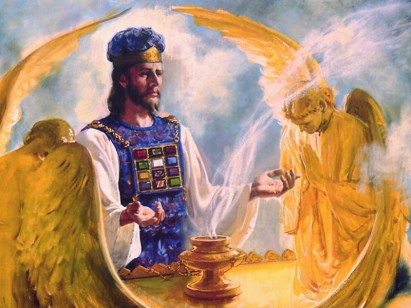
Once a year, on the great Day of Atonement, the high priest dared to enter the final division of the tabernacle, the Most Holy Place. While there, he sprinkled innocent, shed-blood upon God’s ark (Lev. 16:14-15). It was a sacrifice for sin, done firstly on his own behalf, and then on behalf of God’s people (Lev. 4:3-35; 16:11). The result was temporary mediation: The priest was forced to return, time and time again (Heb. 10:11).
The role of such mediation proved to be of very high importance. The high priest sought to mediate between Israel’s iniquity and God’s holiness: He offered shed blood in an effort to “go-between” the vast expanse that sin created between God and His creation. By mediation, the high priest looked to reconcile the needs of both parties, that is, to satisfy man’s need for redemption while also satisfying God’s demand for holiness. He could do this because he served as a representative of both sides. He represented humanity because he was human, and he represented God because he lived as a holy high priest (Lev. 21:1-8). Such reconciliation simply must be achieved before any relation between God and men can occur. And why? Because the divine simply cannot embrace the flawed and fallen! Our holy God is said to be “of purer eyes than to behold evil”, and One who simply “canst not look on iniquity” (Hab. 1:13). Because the high priest was entirely human, and not actually divine, his representative mediation was but momentary, and it’s on this point that the Lord Jesus is found so much better and far-supreme.
Jesus offers a better ministry of meditation because Jesus is both Son of Man and Son of God! He is the one-and-only high priest in history ever to be fully acquainted with both parties involved. He doesn’t merely partake of divine nature, nor does He but represent the divine. Much unlike Aaron, Jesus is both fully man and fully God (Phil. 2:5-8; Jn. 8:58; 10:30). This has made Him the only truly-fruitful mediator between the two:
“For there is one God, and one mediator between God and men, the man Christ Jesus” (1 Tim. 2:5).
“But now hath [Jesus] obtained a more excellent ministry, by how much also he is the mediator of a better covenant, which was established upon better promises” (Heb. 8:6).
As God, the Lord Jesus is able to meet each and every divine demand (Heb. 5:1), and yet, as a man, Jesus also fully sympathizes with our need for merciful redemption (Heb. 2:17; 5:2). Reader, this can never be said of Aaron’s priestly ministry! His mediation was mostly toward the earthen-side, and therefore it proved ever-limited with regard to heaven’s requirement. But Paul declared the mediation of Jesus to be quite different and unrestricted. He is the only High Priest who has “passed into the heavens” (Heb. 4:14). As such, our Lord, though a man, remains free from earth’s stain and “separate from sinners” (Heb. 7:26). His mediation toward God is all-together perfect because it is not hindered by His humanity (Heb. 4:14). Because He ensures perfect mediation we now gain perfect reconciliation: Such perfection of our reconciling builds the final repair of the broken-bridge between God and men! Our union to God is now permitted: it’s said to be “uttermost” instead of widely-gulfed:
“Wherefore he is able also to save them to the uttermost that come unto God by him, seeing he ever liveth to make intercession for them” (Heb. 7:25).
To be continued…
 The Hungry Soul