 Part 9
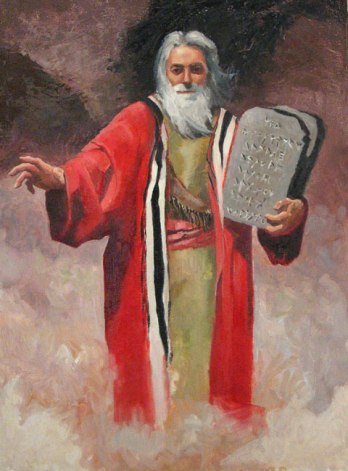
As we’ve been seeing, the Jews of Paul’s day prided their religion on many accounts. One of the most significant reasons for this esteem was because of their relation to Moses. He was considered a their leader and hero! Such fame was due to the fact that God used Moses to impart His special laws, thus making him the most notable legislator in all of human history! He became the very founder of the Jewish, religious economy, and the very medium by which God related to mankind. How can Jesus of Nazareth ever compete with such a famed man? Especially when many Jews misinterpreted Jesus’ humility as a weakness. How will the Lord ever be properly viewed as superior and far-more fruitful? This was Paul’s difficult conflict! Yet, as has been the norm up to this point, Paul skillfully declared the total supremacy of the Lord Jesus by revealing an abundance of spiritual contrast. Jesus is a superior hero! But how so?
The first premise Paul describes is our Lord’s superior rank. Even though Moses was undoubtedly a faithful man, he was faithful as a “servant”, while Jesus proved faithful as a “Son” (Heb. 3:5-6). The contrast is quite clear. Moses indeed can be declared a great man: he was firm and unwavering toward the provocation and rebellion of the Jews (Num. 12:7). And yet, the entire bounty of such faithfulness existed within the lesser confines of human servitude (Exod. 14:31). Jesus proves quite superior. He was faithful to His appointment even when He didn’t have to be; He was not faithful out of subservience and obligation. He entered His Father’s house as the very Master over it, while Moses entered as a servant within it. The home-owner is certainly ranked above any servants working inside.
Secondly, Jesus proclaims a better calling than that of Moses. His ministry was one that awarded a great “heavenly calling”, while the ministry of Moses was primarily of the earth (Heb. 3:1). Moses ministered to an earthly people, namely, natural Israel. Though not absolute, the promises and callings that they sought were primarily related to their temporary, earthen home: They sought mere natural blessing and an earthen promised land. The Lord Jesus proves so far fruitful because His calling is altogether different and supreme: His calling is upward and heavenly: It’s directed toward a people who are strangers and pilgrims on the earth, rather than contented with it (1 Pet. 2:11).
Next, Jesus displays a greater witness than Moses. Moses only spoke of God’s will for creation, while Jesus both declared and displayed it. In Moses, we have but an incomplete shadow – a figure of the true. But in Jesus we see the true and full light (Heb. 8:5; 10:1; Jn. 1:9). He meets our need for a newly-softened heart, while Moses only warned against the threat of evil hardness (Heb. 3:7-8; Ezek. 36:26; Eph. 2:10; Gal. 6:15; Rev. 21:5). To regard Moses over Jesus is to retreat back unto the shadow! Our Lord bears far sweeter fruit!
“For the law was given by Moses, but grace and truth came by Jesus Christ. No man hath seen God at any time; the only begotten Son, which is in the bosom of the Father, he hath declared him” (Jn. 1:17-18).
Further, Jesus functions within a greater ministry. He is the only true “High Priest” of God, while Moses only executed temporary priestly functions (Ps. 99:6; Exod. 24:6-8; Heb. 3:1). Jesus is also the truest of all other “Apostles”, and therefore the finest “sent one” ever to trek through planet earth (Heb. 3:1). His apostleship is eternal while Moses’ ministry was but for a moment.
Next, Jesus wins a better victory than Moses. Moses was not very successful in imparting his love for God to the people that he led through the wilderness. He taught them but could not do much more than that. Despite all his efforts, Moses’ followers ended up ignorant, rebellious, and in deep error (Heb. 3:9-11). They did not know the Lord whom they followed (Ps. 103:7). Jesus, much on the contrary, proves radically different! He offers instruction and imparts the ability to perform it (Jn. 17:1-4, 8). He is far-more fruitful because His personified goodness well-leads us to repentance (Rom. 2:4). We can know God because of His efforts (1 Jn. 5:20; Lk. 10:22). What a help! What a hero!
And finally, Paul reveals the better rest that Jesus awards. The old covenant rest which Moses spoke of was but a natural and temporary rest, while the Lord Jesus shows us rest which is most-substantial, deeply spiritual, and entirely eternal! Old covenant rest was incomplete in this respect: it was only a partial rest. How do we know? Because there were many enemies yet present within the land of Canaan, even after the people of God had possessed it. Paul instructs the Jews toward a far-superior land of rest found in Jesus, that is, a more-perfect and more-total triumph over each and every enemy, and a thorough freedom from all havoc of war (2 Cor. 1:10). God even gives us rest from our religious labors! In Paul’s day, the natural Jew would be well-accustomed to the laborious traditions of his religion. Most of these traditions were but man-made and man-imposed (Mk. 7:1-9). Contrarily, the Lord Jesus offers the sweet fruit of religious liberty, and even shows us how to be made partakers (Heb. 3:14). All we must do is heed Him, not Moses, and enter in to His richer rest (Heb. 3:16-19; 4:1-3). Jesus truly is “Lord of the Sabbath” (Mk. 2:28), something that Moses could never proclaim.
To be continued…
 The Hungry Soul