 Part 5
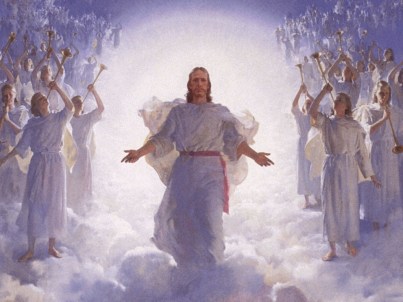
The apostle Paul now directs us toward our Lord’s superiority over God’s angels. It was common Jewish thought in his day to casually dismiss the Lord Jesus as but an angelic manifestation, appearing in human form. To believe any other testimony about our Lord’s identity would be to refute widespread religious dogma. Such a recognition would be quite difficult, again, due to the cultural pride that proved so prominent (Jn. 4:22; Rom. 9:4-5). Paul seeks to refute such a dangerous dismissal as he declares the superior fruitfulness of Jesus. How exactly does he do it? By contrasting the name, position, and nature of both parties. Each of these qualities lends toward far-differing degrees of worthiness and admiration.
Firstly, Paul shows Jesus’ to have a superior name. He’s obtained the greatest of all names, far greater than any angel, even despite His humble condescension into the weakness of human flesh (Heb. 1:4; 2:7). Our Lord should be more-highly exalted simply because He is called “Lord” (Heb. 1:10; Acts 2:36; Ps. 110:1). He alone is named the “firstbegotten” Son, whom the angels do worship (Heb. 1:4). As the first-begotten, Jesus receives a very-well-deserved inheritance. Reader, this can never be said of mere angels!
“Unto which of the angels said [God] at any time, Thou art My Son…?” (Heb. 1:4).
Secondly, Jesus is seated upon a far-better seat, that is, He has a far-better position in the heavens, even at the right hand of God, His Father. Jesus sits upon an eternal throne, and angels simply do not (Heb. 1:7-8; Ps. 11:4). As such, He is “far above all principality, and power, and might, and dominion, and every name that is named, not only in this world, but also in that which is to come” (Eph. 1:20-21). All things, including the angels of God, have been put “under His feet”, as He is “Head over all”, and He triumphs over all lesser fruit (Eph. 1:22; Col. 2:15; Rom. 8:38-39; Col. 1:15-18).
Third, Jesus has a greater nature than that of angels. Jesus is He in whom God’s fullness dwells (Col. 1:19; 2:9). Can this ever be said of angels? Not at all. The angels of God are likened to messengers and are said to be ministering spirits, sent forth to minister to the “heirs of salvation” (Heb. 1:14; Gen. 19:15-16; 32:1-2). While this is quite wonderful, it is not the pinnacle, for Jesus Himself is the very fountain from which such richness flows. All grace and goodness is found only “in Christ” (Eph. 1:3; 1 Cor. 1:30).
And finally, because of Jesus’ superior name, position, and nature, Paul shows Him to receive far-greater admiration. The simple fact that angels worship Him is sufficient evidence of this better fruit. Would angels worship angels? Of course not. God would not allow it, for He alone deserves all praise (Col. 2:18; Rev. 22:8-9; 19:10). Jesus knows a far-better rank and a far-greater dignity. His name, position, and nature have ensured it: He is God! And as God, He is given credit for all of creation (Heb. 1:2, 10), and He rules with a scepter as the King of all kingdoms (Jn. 1:1-3, 10; Eph. 3:9; Heb. 1:8; Isa. 11:4). This is something angels simply cannot declare (Heb. 1:8; Matt. 16:28; Dan. 4:3). As God, the Lord Jesus is declared eternal, while the angels have been created (Heb. 1:11-12; Jn. 1:2). Jesus has been anointed above all lesser “fellows”, even those dwelling in heaven (Heb. 1:9; Jn. 3:34).
To be continued…
 The Hungry Soul