As we know, the T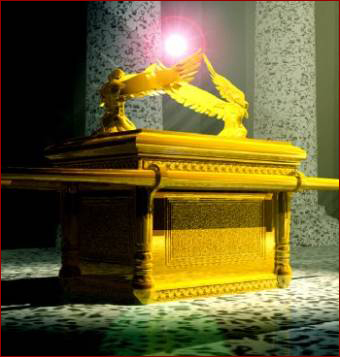 abernacle erected in ancient times was but for a shadow, built according to the heavenly pattern, and meant to cast it’s shade of truth upon our modern New Testament understanding (Rom. 15:4; 1 Cor. 10:11; Heb. 8:5). What were temporary and natural truths for natural Jews have become eternal and spiritual truths for spiritual Jews, that is, the “Israel of God” (Gal. 6:16). The Tabernacle’s many articles of furniture, the ministry of its priesthood, its sacrifices, etc. all point to a much greater truth concerning Jesus and His church. This is the case when observing the Ark of the Covenant and the mercy seat. We’re given the honor of discerning such rich truth (Prov. 25:2).
Its Special Significance..
The Ark was composed of wood, overlaid with pure gold. The lid of the Ark was called the mercy seat: it was made of pure gold, having no wood in its composition. It was set “above upon the Ark” (Ex. 25:21).
There was only one other piece of furniture in the Tabernacle made solely of gold: the golden candlestick. The candlestick was much smaller in size and weight, and therefore, according to intrinsic value, the mercy seat was the most valuable of all the holy vessels! This greatly tells us of the preciousness that the mercy seat foreshadowed!
Inside the Ark, underneath the mercy seat (lid), was placed the law on tables of stone, Aaron’s rod that budded, and a golden pot of manna (Heb. 9:4). These items were kept as a memorial (Ex. 16:33:34; 25:21; etc.).
To the earthly Jew, the Ark of the Covenant came to represent God’s manifest presence in the earth. After all, it was considered the throne of God, or the seat upon which He rested in His great glory, beheld by the cherubim. In the New Testament, Paul interprets the special significance of the Ark for us:
“Being justified freely by his grace through the redemption that is in Christ Jesus: Whom God hath set forth to be a propitiation through faith in his blood, to declare his righteousness for the remission of sins that are past, through the forbearance of God” (Rom. 3:24-25).
The verb “propitiate” means “to appease, to placate, to make satisfaction.” As is commonly taught, the word “propitiation” is also translated “mercy seat“. Jesus is the personification of the mercy seat! God the Father has been calmed and settled in His holy wrath against sin, all because of the personified “propitiation” of His Son, Jesus. The righteous demands of the Law have been wholly satisfied! His is the only sacrifice that pacifies God’s offended justice. King Jesus is the single, costly, precious article to which we owe our nearest and dearest affections: He is the Chief focus of God’s tabernacle; He is its end. In Him alone do we find true fruitfulness (Aaron’s rod that budded), freedom from law (tables of the covenant), and the bread of life (golden pot of manna)!
Its Role and Function..
As one writer duly notes, there were no chairs in the tabernacle. How odd? There was a table, but no chairs. Why? Because the work done therein was never completed! Its demands were perpetually heard by the ministering priests; sin was never fully and completely dealt with. Therefore, who could take his rest? What purpose would a chair serve? None at all. However, there was indeed a rest to come. There was a seat behind the second veil – namely, the mercy seat. The mercy seat that rested upon the Ark well-foreshadowed the wondrous truth to come: God would find His rest in that perfect work which His incarnate Son would perform. This was the place of God’s rest – finally a seat, a throne upon which He could sit and meet with a purged creation:
“And thou shalt put the mercy seat above upon the ark; and in the ark thou shalt put the testimony that I shall give thee. And there I will meet with thee, and I will commune with thee from above the mercy seat, from between the two cherubims which are upon the ark of the testimony, of all things which I will give thee in commandment unto the children of Israel” (Ex. 25:21-22).
The fact that the mercy seat formed God’s restful throne in the midst of Israel is referred to in a number of Scriptures. In 1 Samuel 4:4 we read, “So the people sent to Shiloh, that they might bring from thence the ark of the covenant of the LORD of hosts, which dwelleth between the cherubims“. 2 Samuel 6:2 says, “And David arose, and went with all the people that were with him from Baale of Judah, to bring up from thence the ark of God, whose name is called by the name of the LORD of hosts that dwelleth between the cherubims“.
Hezekiah addressed his prayer to God as “O Lord God of Israel, which dwellest between the cherubim” (2 Kgs. 19:15), while the Psalmist cried, “Give ear, O Shepherd of Israel, Thou that leadest Joseph like a flock; Thou that dwellest between the cherubim, shine forth” (Ps. 80:1)! The references are endless.
But how could such a holy God dwell, sit and rest in the midst of such a sinful and rebellious people? The answer is only seen upon the grounds of accepted sacrifice. His throne was a blood-sprinkled one (Lev. 16:14). The blood of the sin offering was sprinkled upon the mercy seat, and there that blood was left to remain. It was left as a testimony that God’s justice had been met, though temporarily (Heb. 10:4). Because of this blood, God could righteously dwell in the midst of a people who had broken His law. Their sin had been covered-over for the time being! What a glorious type this is! Reader, can we realize the great benefit that has become our very own? If the blood of bulls and goats could provide a dwelling of God among His people, how much more can the shed blood of Jesus enable a holy housing of the same (Heb. 9:12-14)! By this perfectly-substantial and sinless blood, redemption has been wholly obtained (Heb. 9:12); God’s dwelling is to become our inheritance!
Its Measurements..
As we know, anything and everything of any typical import was recorded in Scripture in a scrupulous manner, as to never miss a detail in its description, format or appearance. Of course, this is the case with the mercy seat as well. What do the detailed descriptions tell us of this throne’s lid? What special significance’s do these measurements and numbers display? Let’s observe..
The length of the Mercy Seat was two and a half cubits; the breadth was one and a half cubits (Ex. 25:17). Nothing, however, is told us of its thickness. What an interesting omission when compared to Psalm 103:11-12:
“For as the heaven is high above the earth, so great is his mercy toward them that fear him. As far as the east is from the west, so far hath he removed our transgressions from us“.
Firstly, let’s consider the length: two and a half cubits. The number two in Scripture repeatedly speaks of witness and separation (Deut. 19:15; 17:6-7; 2 Cor. 13:1; Jn. 8:17; Heb. 10:28; Mk. 6:41; Matt. 24:40-41). The Ark then, and it’s mercy seat, was to be both a witness of God’s revealed presence in the earth, as well as a dividing line between God’s people and His foes: It was a witness to Israel and a separation to her foes. It was both a proof (witness) and a barrier (of separation). What was a blessed symbol to one (the Israelite), was a wretched symbol to another – a symbol of utter and imminent defeat! Wherever the Ark went, disaster was sure to strike for the enemies of God. Dear reader, the same is so with all New Testament saints. The merciful presence of God is our very life-blood, our victory, and our only means of overcoming the world! It is our witness and separation too!
Next, let’s consider the breadth: one and a half cubits. The number one in Scripture is representative of unity, God who is the beginning, or that which is first (Deut. 6:4; Jn. 17:20-22; Acts 4:32; 1 Pet. 3:8; Jn. 1:1-3; Rev. 1:11; Isa. 41:4; 44:6; 48:12). This tells the studious reader that the Ark of God was to be a unifying factor for His people. For New Testament saints, we see that such communion in the Holy Ghost is the only true means by which we can achieve true corporate unity (Eph. 4:16). The body of Christ, apart from an attachment to God’s Ark, proves to be an utter, tangled, and dis-unified mess!
Furthermore, the number one here also represents how God has, from the very beginning, desired to make His abode with mankind. In fact, this was our Lord’s first and chiefest motive in creating the world, and His basis for slaying His Lamb from the foundation of it (Rev. 13:8). He has created man for rich fellowship:
“Thou art worthy, O Lord, to receive glory and honour and power: for thou hast created all things, and for thy pleasure they are and were created” (Rev. 4:11).
Yes, the Lord hath made all things for Himself (Prov. 16:4), and therefore “of Him, and through Him, and to Him” are all things (Rom. 11:36). What wonderful evidence we find for this in the dimensions of the mercy seat – God’s throne of communion in the earth!
Its Ornamentation..
Upon the mercy seat were two “cherubims“, one at either end. These figures were made of the same slab of gold as the Mercy Seat, and were beaten into shape (Ex. 25:17-19). The identity, role and purpose of these figures seems to have baffled most scholars for centuries. Who are these cherubim? Why are they atop the mercy seat? What do they represent for us?
In short, the significance of these cherubim are found in the fact that they “overshadow” God’s throne, ever-protecting, as it were, His precious glory (Heb. 9:5). That there is some profound import connected with these figures is quite obvious from the words of Paul:
“And over it the cherubims of glory shadowing the mercy seat; of which we cannot now speak particularly” (Heb. 9:5).
How peculiar? Paul says there is much to be said of these creatures, yet the Hebrews could not yet hear it. They were likened to spiritual babes and would inevitably choke if fed such “strong meat” (Heb. 5:12-14). Only those saints who are “exercised” in God’s truth will ever properly glean what these cherubim point to.
The first time these cherubim are mentioned in Scripture is the account in Genesis, directly after the fall of man:
“So he drove out the man; and he placed at the east of the garden of Eden Cherubims, and a flaming sword which turned every way, to keep the way of the tree of life” (Gen. 3:24).
Here, they are said to have a flaming sword, guarding the way to the Tree of Life. This account, coupled with their description on the mercy seat, seem to tell us that these cherubim have some association with administering God’s judicial authority in the earth. Much can be said regarding their identity, their position, and their role, but we cannot address it now. Let it be sufficient for now that we acknowledge the great volume of truth held therein: there is much more about these beings than first meets the eye. You’ll want to tune in at a later date for a detailed research.
Its Blessedness..
It is no accident that the Ark and its mercy seat are completely hid from natural view, and had very restricted access. They reside behind the Tabernacle’s second veil, far away from all natural sunlight, and even far from the candlelight of the Holy Place. The only light in this realm is that of the visible glory of God shining forth off the Ark (Ps. 80:1, 3; 50:2; 94:1; Ezek. 43:2; Dan. 9:17; Rev. 21:23). As such, we see this final veil to be that realm reserved for those who choose to wholly seek after it (Jer. 29:13; 3:10; 24:7; Deut. 30:2, 10; Ps. 119:2, 10, 58, 69, 145; Joel 2:12; Acts 8:37). It is only the hungry and the thirsty who will readily be filled with what God is offering to humanity’s race (Matt. 5:6). God is One who desires to be sought after; why else would He rend His heart in such a way, even sending His own incarnate Son to purchase a people for Himself? He has done so to draw forth all men (Jn. 12:32; Rom. 5:17-19; 1 Tim. 2:6). Whosoever will, let him come! Let him push pass the throngs of mere form and religion, through the bloody outer court, through all natural sunlight, through the Holy Place and the ministry focused upon men (Ezek. 44)! God is waiting for a people to apprehend Him! He is patiently waiting upon His throne of mercy, ever-looking for the fruit of the earth to fully ripen (Jas. 5:7). Will you be one who follows after your inheritance? Will you be one who recognizes God’s great desire? Will you fully follow after Jesus, the blessed Forerunner? He has gone to that realm as a trailblazer, and now enables us to follow (Heb. 6:19-20)! His most-holy blood has been well-sprinkled, the privilege of access can be ours! Communion with your Maker is awaiting! These precious details of the mercy seat prove such to be so.
“Let us therefore come boldly unto the throne of grace, that we may obtain mercy, and find grace to help in time of need” (Heb. 4:16)!
 The Hungry Soul