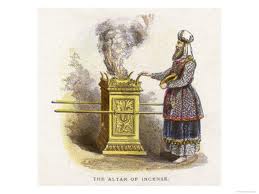
 In the book of Exodus, Scripture tells us of the specific ingredients for the incense that was to continually burn upon the golden altar, in the Holy Place of Moses’ tabernacle. As this incense burned, its fragrant aroma and mystical smoke wafted through the final veil, into the very presence of God. As students of the Bible, we know this incense to be clearly symbolic of the prayer and worship of the saints (Rev. 5:8; 8:3-4; Ps. 141:2).
We know this incense to be symbolic. That much is clear. But do we realize the certain composition that this incense possesses? It was very specific. And not only that, it was to be pure:
“And the LORD said unto Moses, Take unto thee sweet spices, stacte, and onycha, and galbanum; these sweet spices with pure frankincense: of each shall there be a like weight: And thou shalt make it a perfume, a confection after the art of the apothecary, tempered together, pure and holy: And thou shalt beat some of it very small, and put of it before the testimony in the tabernacle of the congregation, where I will meet with thee: it shall be unto you most holy” (Ex. 30:34-36).
In a day and age when worship is often anything but pure, may we ever more cling to the Word of God, our only perfect guide for any and all approach to God. It was only pure incense that would ever make it’s way into the Most Holy Place, and likewise, it is only pure worship that will ever usher the believer into the place of communion, the Most Holy Place. Many may be wondering why they struggle to find God’s presence. Why do some saints seem to sweat as they strive to enter into God’s glory? Could it be due to the state of our incense? Could it be that our offering is impure? I believe so. Men are mistaking if they assume they can but waltz into the presence of a holy God. Rather, the heart of man must be rightly prepared (Mk. 4:1-20)! The glory of God is carried in upon the shoulders of His priests (1 Chron. 15:15)!
Look what the Lord says about His people when their incense is given over to idols:
“I hate, I despise your feast days, and I will not smell in your solemn assemblies. Though ye offer me burnt offerings and your meat offerings, I will not accept them: neither will I regard the peace offerings of your fat beasts. Take thou away from me the noise of thy songs; for I will not hear the melody of thy viols. But let judgment run down as waters, and righteousness as a mighty stream. Have ye offered unto me sacrifices and offerings in the wilderness forty years, O house of Israel? But ye have borne the tabernacle of your Moloch and Chiun your images, the star of your god, which ye made to yourselves” (Amos 5:21-26).
“Know ye not that a little leaven leaveneth the whole lump?” (1 Cor. 5:6).
Malachi reassures us that our worship is to remain pure and free from mixture! “For from the rising of the sun even unto the going down of the same my name shall be great among the Gentiles; and in every place incense shall be offered unto my name, and a pure offering: for my name shall be great among the heathen, saith the LORD of hosts” (Mal. 1:11).
Truly, God is looking for those whose worship flows from a contrite and “collapsed” heart (Ps. 51:16-17; Hos. 6:6; Mic. 6:6-8). All the more reason to let the fire of God purify us (Heb. 12:8-11; Mal. 3:2-4)! It will make our offering ever-purer.
As aforementioned, the certain ingredients of the incense are an important detail too. As we examine each one, we will learn a valuable lesson in proper worship (Jn. 4:23-24).
Not surprisingly, each ingredient of the incense was either obtained by death, or used for death (burial). These ingredients were stacte, onycha, galbanum, and frankincense. Each component was to be beaten “very small“, thus insisting, once again, upon the utter purification that proper incense was to possess.
Stacte is the purest form of myrrh available. Myrrh is a burial spice. Who can fail to see the significance here? A dying saint is a saint chasing pure worship, while a saint clinging to his carnality will be one with little to offer God (Jn. 3:30; Gal. 4:19).
Onycha is an extract that only emits an odor when thoroughly burned. Once again, we see the burning and purging that must be performed for our odor to be “acceptable“. Jesus’ scent was made perfect by His suffering, and ours will be as well (Heb. 5:8-9).
Galbanum is a gum that, when added, makes the incense last longer. Galbanum is only obtained by breaking and stripping the stalks of its plant. In other words, this plant’s stalk, like the believer, must first be broken down before any good and aromatic use can come of it. How interesting that the stripping away of this gum made the incense most-perpetual and thereby ready at a moment’s notice. Reader, our spiritual aromas will likewise be most-frequent as we seek to strip our worship of its flesh.
Lastly, frankincense is a bitter vegetable resin. To obtain this resin, one must extract it from the core of its tree, thoroughly cutting away the bark. Then, and only then, would the pure frankincense come forth. The similitude is quite obvious. Do we think it a coincidence that these four ingredients that composed the incense are all obtained in a manner of death and dying, burning and cutting? The incense could only properly be offered as these deadly events took place. Similarly, the believer can only offer his or her own best fragrance when utter death-to-self is involved. A saint who oft finds himself within the Most Holy Place will be a saint who is no longer carnally significant! The aroma of his life will have been altered. Oh what sweet fruit this must be to King Jesus!
“I am crucified with Christ: nevertheless I live; yet not I, but Christ liveth in me: and the life which I now live in the flesh I live by the faith of the Son of God, who loved me, and gave himself for me” (Gal. 2:20).
As is clear from the above reference to Galatians, the apostle Paul was a remarkable example of this truth. He was a man who made Zion his very home. He was so enraptured by God’s glory that he didn’t even know whether he was in or out of the body (2 Cor. 12:3)! He even said that he had the choice to stay or to go! And do we think it’s a coincidence that this was the very same man who died “daily” (1 Cor. 15:31)? Of course not, this can be no mere accident. The purity of one’s worship is directly related to the measure of escape upon Zion that is realized, and the holiness of one’s own personal fragrance is directly related to the glory to be walked in upon the earth! God desires pure incense upon the altar of my heart. Not just for His sake, but for my sake too.
For me personally, such a truth as this helps me better understand God’s longing, and better endure His furnace (Mal. 3:2-4). I know that real purity is slowly being assimilated into my carnal being, and the reward will justify the journey. One day, my offering will be purer than pure and whiter than snow. Jesus will be quite pleased, for real and lasting fruit will have been grown. Amen.
 The Hungry Soul
No comments: